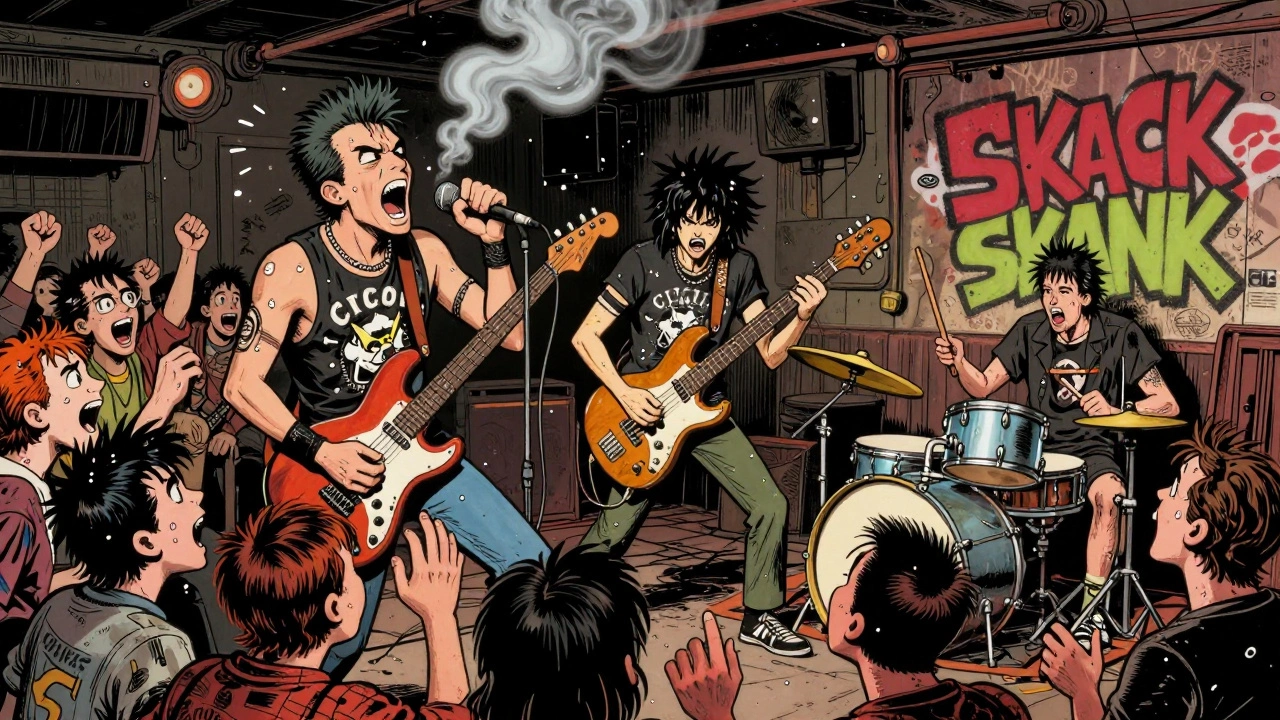

When you think of punk rock, you might picture safety pins, ripped jeans, or shouted lyrics about boredom and anger. But in 1980, a band from Hermosa Beach, California, turned that anger into a lightning bolt. Circle Jerks’ Group Sex wasn’t just an album-it was a 15-minute explosion that redefined what hardcore punk could sound like. No frills. No solos. No mercy. Just 14 songs crammed into less time than it takes to microwave a burrito.
Before Group Sex, punk was already loud. Bands like the Sex Pistols and The Clash had made noise about rebellion. But Circle Jerks didn’t just scream-they detonated. The album came out in late 1980, right when the Los Angeles punk scene was shifting from the messy, artsy vibe of the mid-70s into something faster, meaner, and more brutal. This wasn’t the kind of punk you danced to. This was the kind you slammed into.
Who Were Circle Jerks, Really?
Circle Jerks didn’t start as a polished act. They were a last-minute project. Keith Morris, the frontman, had just walked out of Black Flag after their first EP, Nervous Breakdown. He was angry, wired, and ready to scream again. He teamed up with Greg Hetson, a guitarist who’d played with Redd Kross and knew how to turn chaos into structure. Together, they grabbed bassist Roger Rogerson and drummer Lucky Lehrer-two guys who didn’t even play punk before. Rogerson had classical training. Lehrer came from jazz. That’s not the typical punk lineup. But it worked.
Their sound was a paradox: raw, but precise. Morris’s voice cracked like a whip, spitting out lines like “I’m a punk, I’m a jerk, I’m a loser, I’m a fool” with a grin. Hetson’s guitar didn’t just blast-it clicked, snapped, and pivoted. Rogerson’s bass lines moved like a machine, and Lehrer’s drums didn’t just pound-they danced. You could hear it in songs like “Golden Bear” and “Walter’s Place.” It wasn’t mindless noise. It was calculated fury.
Group Sex: 15 Minutes of Pure Punk
Think about that number: 14 songs in 15 minutes. That’s an average of 64 seconds per track. Most of them are under a minute. “Beverly Hills” is 38 seconds. “The Party’s Over” is 47. “Burning Up”? 51. No intro. No breakdown. No pause. Just punch after punch. The album doesn’t ask you to listen. It demands you react.
Lyrically, it was messy, funny, and sharp. “Group Sex” (the title track) wasn’t about what you think. It was about the absurdity of conformity, wrapped in sarcasm. “I’m a Punk” was a self-aware anthem for misfits who knew they were hated. “Beverly Hills” mocked the rich while stomping on their lawns. These weren’t political manifestos. They were graffiti on the wall of American suburbia.
The production? Barely there. Recorded in a tiny studio with cheap gear. You can hear the tape hiss. You can hear the amp buzz. You can hear the sweat. That wasn’t a flaw-it was the point. This wasn’t music for radio. It was music for basements, for squats, for shows where the cops showed up before the last song.
The Decline of Western Civilization and the Birth of a Legend
Just four months after forming, Circle Jerks were in a documentary that would change everything. Penelope Spheeris’s The Decline of Western Civilization captured the LA punk scene in its rawest form. The film showed Circle Jerks onstage, Morris screaming into a mic, the crowd slamming into each other like human pinballs. It wasn’t pretty. It wasn’t polished. But it was real.
The film dropped in July 1980. It scared the hell out of the LAPD. Police chief Daryl Gates called it “a threat to public order.” But kids didn’t care. They watched it on VHS, passed it around, taped it from TV. Suddenly, Circle Jerks weren’t just a local band. They were a symbol. And that “Skank Man” logo-drawn by Shawn Kerri-started appearing on t-shirts, zines, and walls. It wasn’t just a mascot. It was a battle cry.
Why This Album Still Matters
Most punk albums from the 80s are forgotten. Bands broke up. Labels folded. Cassettes rotted. But Group Sex didn’t just survive-it thrived. Why? Because it captured something no one else did: the exact moment when punk stopped being a fashion statement and became a force.
Listen to it today. A 25-year-old in 2024 told me, “I feel like it’s music that will never age.” He’d just seen them live in Portland. He got a tattoo of the Skank Man after that show. He didn’t grow up in the 80s. He wasn’t there. But he felt it. That’s rare.
It’s not just the speed. It’s the attitude. The album didn’t try to be smart. It didn’t try to be deep. It just was. And that honesty? That’s what makes it timeless. You don’t need to know the history to feel it. You just need to be pissed off.
Other bands tried to copy it. Some got faster. Some got heavier. But none got the balance. Circle Jerks knew how to be ridiculous and deadly at the same time. They made you laugh, then made you want to break something.
The Legacy That Still Moves
Decades later, you can still find Group Sex in record shops, on Bandcamp, and in the playlists of metalheads, hardcore kids, and even indie rockers. Bands like Fugazi, The Offspring, and even early Green Day owe something to this record. It proved that punk didn’t need to be long to be powerful.
And the Skank Man? He’s still out there. On hoodies in Tokyo. On murals in Berlin. On the Instagram feeds of kids who weren’t born when the album came out. He’s not just a drawing. He’s proof that rage, when done right, doesn’t fade.
Circle Jerks never said they were changing the world. They just showed up, played fast, screamed loud, and left. But they did. And Group Sex? It’s still screaming.
What year did Circle Jerks release Group Sex?
Circle Jerks released Group Sex in 1980. It was their first full-length album and came out just months after the band formed. The recording was done quickly, in a small studio, and the album was pressed on vinyl with minimal production-perfect for the raw energy of early hardcore punk.
Who were the original members of Circle Jerks on Group Sex?
The original lineup for Group Sex included vocalist Keith Morris (ex-Black Flag), guitarist Greg Hetson (ex-Redd Kross), bassist Roger Rogerson, and drummer Lucky Lehrer. Morris and Hetson were the founders, while Rogerson and Lehrer brought unusual musical backgrounds-classical training and jazz influences-that helped shape the album’s tight, aggressive sound.
Why is Group Sex considered a landmark hardcore punk album?
Group Sex set the template for hardcore punk with its brevity and intensity. At just 15 minutes long with 14 tracks, it proved that punk didn’t need long songs to make an impact. Its unpolished production, fast tempos, and sarcastic, angry lyrics became a blueprint for countless bands that followed. It also gained massive exposure through the documentary The Decline of Western Civilization, which cemented its cultural importance.
What role did The Decline of Western Civilization play in Circle Jerks’ success?
The documentary The Decline of Western Civilization, released in 1980, featured Circle Jerks performing live alongside Black Flag and X. It gave them national exposure at a time when punk was still underground. The film’s raw footage of mosh pits and police crackdowns made the band iconic. Even though the LAPD hated it, fans loved it-and the documentary was later added to the U.S. National Film Registry in 2016.
Is Group Sex still influential today?
Absolutely. Decades after its release, Group Sex continues to influence new generations of punk, hardcore, and even alternative bands. Fans still get tattoos of the Skank Man logo. Young listeners discover it through documentaries and streaming. Bands like Fugazi, The Offspring, and early Green Day have cited it as a key influence. Its short, fast, and fearless style remains a gold standard in punk music.


