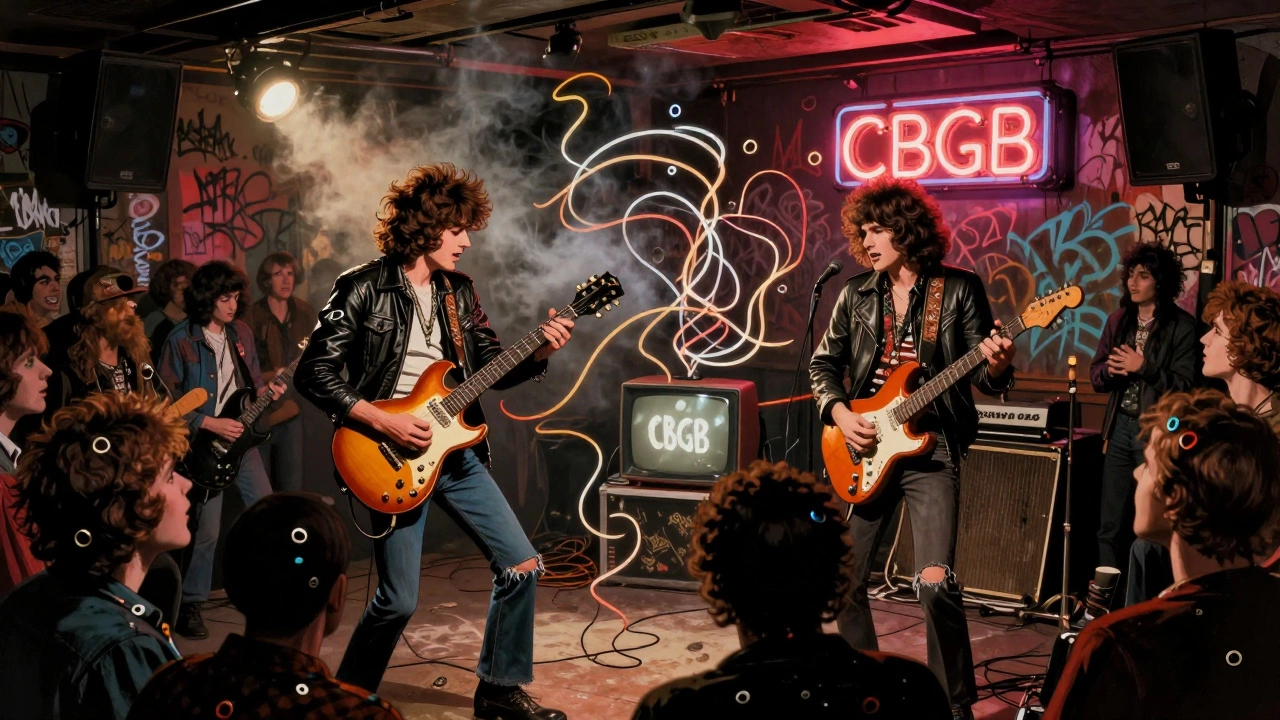

On a cold night in March 1974, a band took the stage at CBGB in New York City and played something no one had heard before. No fast power chords. No shouted slogans. Just two guitars weaving around each other like dancers in a dark alley, vocals half-sung, half-spoken, lyrics dripping with poetry and grit. That band was Television. And they weren’t just playing music-they were rewriting what punk could be.
What Made Art-Punk Different
Most people think punk started with the Ramones: three chords, ten seconds, and a sneer. But in New York, a different kind of punk was brewing. It wasn’t about rebellion for rebellion’s sake. It was about rebellion through ideas. Art-punk didn’t reject complexity-it embraced it. While British punk bands like the Sex Pistols screamed about anarchy, New York artists like Television and Richard Hell were reading Burroughs, listening to free jazz, and painting their own album covers. This wasn’t music made in a garage. It was made in lofts, in cheap apartments on the Lower East Side, where rent was $200 a month and the walls were covered in collages of old magazines, newspaper clippings, and spray-painted slogans. The scene wasn’t just about sound-it was about style, language, and visual chaos. Safety pins weren’t just for holding torn clothes together. They were a statement. A middle finger to polish. A declaration: you don’t need to be perfect to be powerful.Television: The Guitarists Who Broke the Rules
Tom Verlaine and Richard Lloyd didn’t play guitar like rock stars. They played like poets with wire and wood. On the album Marquee Moon, released in February 1977, the title track stretched past ten minutes. No chorus. No bridge. Just two guitars locking into a hypnotic loop, building tension like a jazz solo that never resolves, then falling apart like a dream you can’t quite remember. It took 17 takes to record it. Brian Eno, the producer, later said it was the most disciplined chaos he’d ever heard. This wasn’t technical show-off. It was emotional precision. Verlaine didn’t want to play fast. He wanted to play true. Each note had weight. Each silence had meaning. Critics called it overlong. Fans called it life-changing. Today, Rolling Stone calls it one of the 500 greatest albums ever made. And it sold barely 65,000 copies when it came out.Richard Hell: The Man Who Gave Punk Its Look-and Its Voice
Before Johnny Rotten had his mohawk, before the Sex Pistols had their snarling logo, Richard Hell was walking down Avenue B with ripped shirts, safety pins holding his pants up, and the word “PUNK” scrawled across his chest in black marker. He didn’t invent the look. He perfected it. And he made it mean something. His band, Richard Hell and the Voidoids, released Blank Generation in 1977. The title track wasn’t a cry of despair. It was a manifesto: I was born with a blank generation / I got nothing to say. It sounded like a poem shouted into a broken microphone. The lyrics drew from Rimbaud, from Burroughs’ cut-up technique. The music was jagged, unpredictable. One moment it was a garage stomp, the next it was a slow, eerie crawl. Hell didn’t care if people understood him. He cared if they felt it. He once said, “I wanted to play one note and mean it.” That’s the heart of art-punk: not how many notes you play, but how much you pack into each one.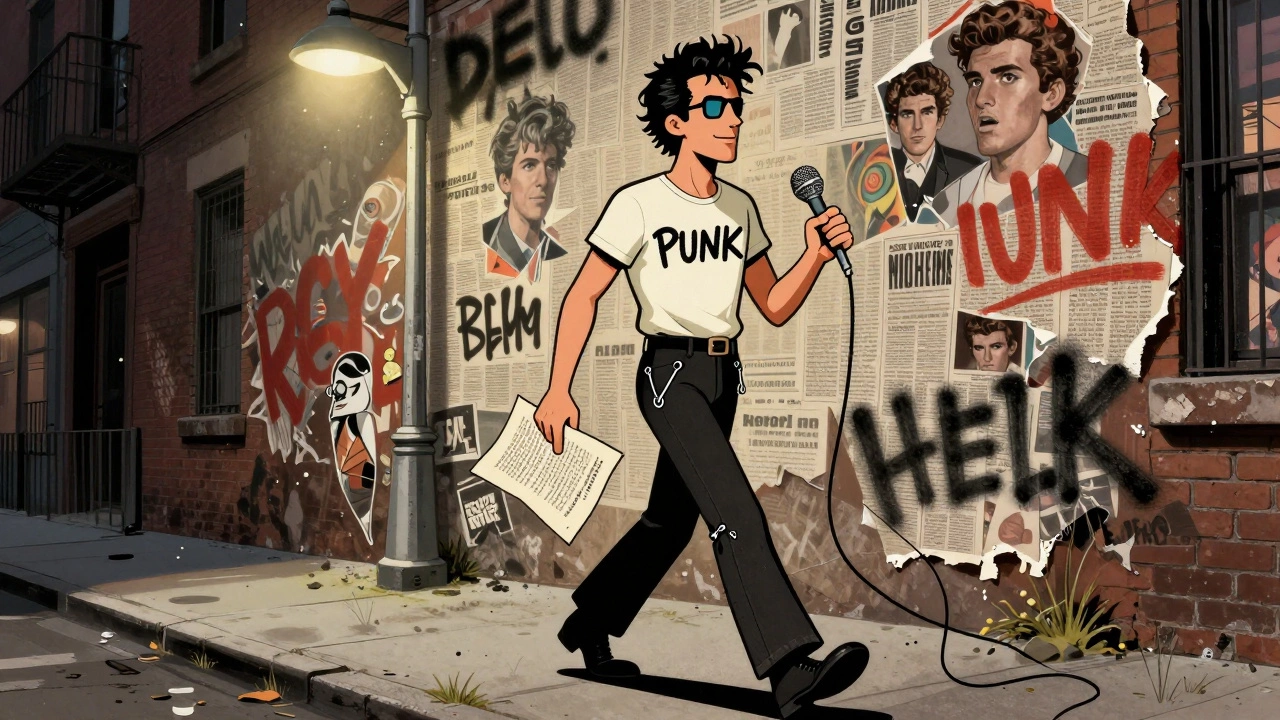
The Scene: CBGB, Cheap Rents, and No Rules
CBGB wasn’t built for punk. Hilly Kristal opened it in 1973 for country, bluegrass, and blues. But by 1974, the only bands willing to play for $50 were the weird ones-the ones with spiky hair and poetry in their pockets. So he let them in. And they filled the room. The Lower East Side in the mid-70s was a ghost town. After decades of decline, whole blocks sat empty. Rents were dirt cheap. Artists moved in. Writers, painters, filmmakers, musicians-all of them broke, all of them desperate to make something real. No one was watching. No one was in charge. That’s when art-punk exploded. Patti Smith read poetry over feedback. Talking Heads played angular funk with a nervous energy. Blondie, before she was a pop star, was a punk with a cigarette and a sneer. And all of them shared one thing: they didn’t wait for permission. They made their own labels, their own posters, their own shows.Why It Didn’t Go Mainstream
Art-punk never sold millions. It didn’t want to. But its influence was everywhere. Major labels didn’t get it. Elektra Records signed Television only after a critic named Richard Meltzer begged them to. Richard Hell’s Blank Generation came out on Ork Records-a tiny label run by a friend who had a tape machine and a dream. No radio play. No TV appearances. No marketing. Just word of mouth, zines, and flyers taped to subway walls. The music was too smart, too strange, too quiet for the mainstream. But it was loud enough for the next generation. Sonic Youth cited Television as their Bible. Nirvana covered Richard Hell. R.E.M. built their jangle-pop sound on the same guitar interplay Verlaine and Lloyd pioneered. Even today, bands like IDLES and Fontaines D.C. carry that same mix of poetry and rage.
The Legacy: From No Wave to Digital Punk
By 1978, the original art-punk scene began to fracture. Patti Smith moved toward rock stardom. The Ramones started sounding more polished. And in the vacuum, something even stranger emerged: No Wave. Bands like Teenage Jesus and the Jerks played music that didn’t bother with melody at all. It was noise. It was anger. It was art. But the real legacy wasn’t in the music-it was in the mindset. Art-punk taught a generation that you didn’t need a degree, a record deal, or a perfect voice to make something that mattered. You just needed an idea, a pair of scissors, and the courage to stick it on a wall. Today, ABC No Rio-the collective space founded in 1980 by former punk artists-still hosts shows, art exhibits, and poetry readings. It’s not a museum. It’s alive. And every time someone posts a DIY zine on Instagram, or paints a slogan on their hoodie, or writes a song with no chorus and no bridge… they’re still living in the shadow of Television and Richard Hell.How It Changed Everything
Art-punk didn’t change music. It changed the idea of who could make it. Before CBGB, rock was a business. After it, rock was a room full of people who didn’t care if they were noticed-only if they were honest. Television’s Marquee Moon sold 500,000 copies in 2002. Not because it was popular then. But because it was true. And truth, eventually, finds its audience. Richard Hell never became a superstar. But if you’ve ever picked up a guitar because you didn’t know how to play, or written a poem because you had nothing to say, or made a poster out of glue and scraps because you couldn’t afford anything else-you’re part of his legacy. Art-punk wasn’t a genre. It was a permission slip.What’s the difference between art-punk and regular punk?
Regular punk, especially in the UK, focused on raw speed, simple chords, and aggressive slogans. Art-punk, especially in New York, mixed that energy with poetry, avant-garde art, jazz-influenced guitar work, and literary references. Bands like Television and Richard Hell didn’t just play fast-they played with intention. Their songs had structure, but it was unconventional. Their lyrics were dense, not shouted. Their sound was messy, but carefully so. It wasn’t rebellion for noise’s sake-it was rebellion as a form of art.
Why did art-punk come out of New York and not somewhere else?
In the 1970s, New York City was broke. After World War II, the population dropped, neighborhoods emptied out, and rent became incredibly cheap. The Lower East Side became a haven for artists, writers, and musicians who couldn’t afford to live anywhere else. With no money, they had to make their own tools: their own music, their own posters, their own labels. That scarcity bred creativity. There was no industry to please, no rules to follow. Just a room, a guitar, and a need to say something real.
Was Richard Hell really that influential?
Yes. He didn’t just play music-he shaped punk’s entire visual identity. His ripped clothes, safety pins, and spiky hair became the blueprint for punk fashion before the Sex Pistols even formed. His lyrics, influenced by Beat poets like Burroughs, introduced literary depth to punk songwriting. And his band, the Voidoids, created one of the most sonically daring punk albums ever. Without Hell, punk might have stayed loud and dumb. He made it smart, strange, and unforgettable.
Did art-punk have any commercial success?
Not at first. Television’s Marquee Moon sold only about 65,000 copies in its first year. Richard Hell’s Blank Generation sold under 40,000. But over time, the influence grew. The album was certified gold in 2002, 25 years after release. Critics called it a masterpiece. Bands like Sonic Youth, R.E.M., and Nirvana cited it as foundational. Commercial success came late-but cultural impact was immediate and lasting.
How did art-punk lead to other genres?
When the original art-punk bands faded or moved on, the scene didn’t die-it split. No Wave emerged as a more abrasive, experimental offshoot, with bands like Liquid Liquid and DNA pushing sound into pure noise. Meanwhile, bands like Sonic Youth took Television’s guitar textures and mixed them with feedback and distortion, creating the foundation for indie rock. Even today, genres like post-punk, math rock, and lo-fi indie owe their complexity and emotional depth to the experiments of New York art-punk.


