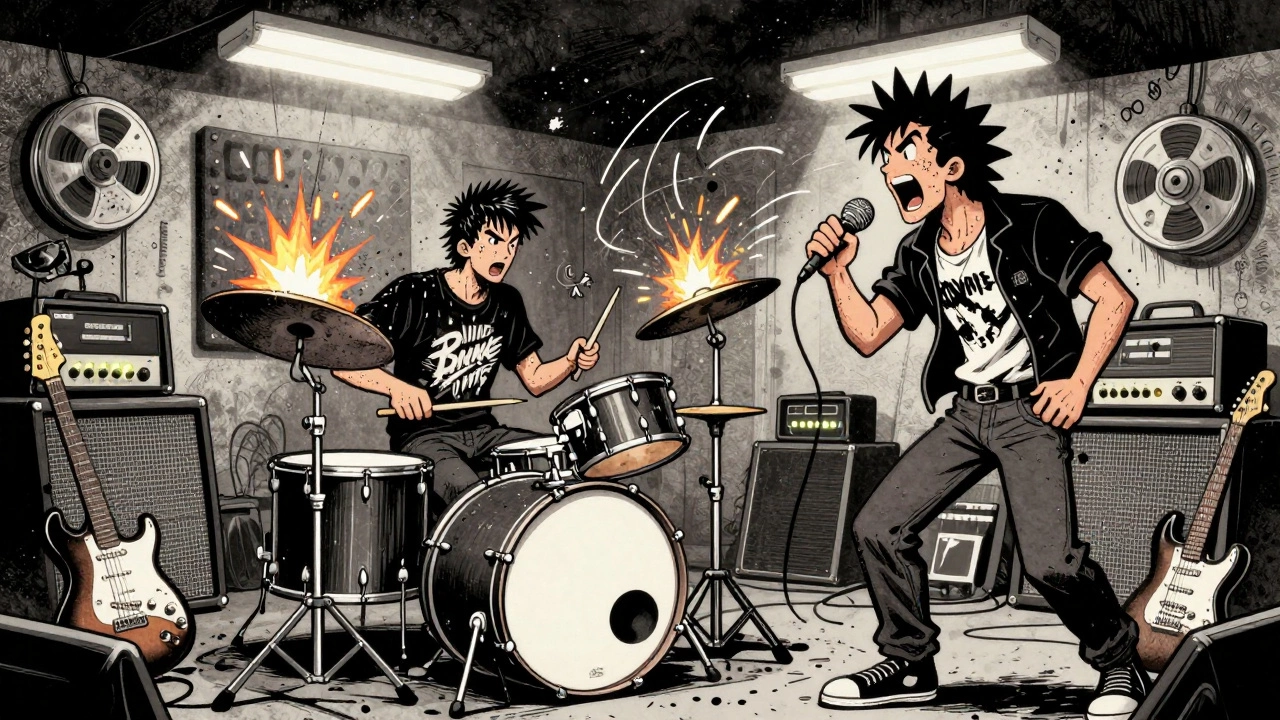

When you hear a 1990s punk album like NOFX’s Punk in Drublic or The Offspring’s Smash, you don’t just hear music-you feel it. The snare cracks like a whip. The kick hits like a hammer. The guitars scream through a wall of tape saturation. And the vocals? They’re right there in your face, barely hanging on, like the singer just ran in from the parking lot and grabbed the mic. This wasn’t an accident. It was a carefully engineered sound, born out of budget limits, fast schedules, and a stubborn refusal to sound polished.
Why Fast Takes Were the Rule, Not the Exception
In the 1990s, most punk bands didn’t have months to record an album. They had five days. Sometimes less. Epitaph Records, the label behind bands like Bad Religion and NOFX, typically gave bands $8,000 to $12,000 to record, mix, and master an album. Adjusted for inflation, that’s about $18,000 today. Compare that to modern rock albums that cost $200,000+ and you’ll see why speed wasn’t just preferred-it was necessary.Recording sessions followed a strict order: drums first, then bass, then guitars, then vocals. Drums were tracked in one or two days. No click tracks. No quantization. No editing. If the drummer messed up a fill, they did it again. Right then. The goal wasn’t perfection-it was energy. As producer Ryan Greene said after working on NOFX’s Linoleum, "We tuned the kick drum to E because that’s the key of the song. That gave it this huge thump without any EQ. We didn’t fix it later. We just made sure it hit right the first time."
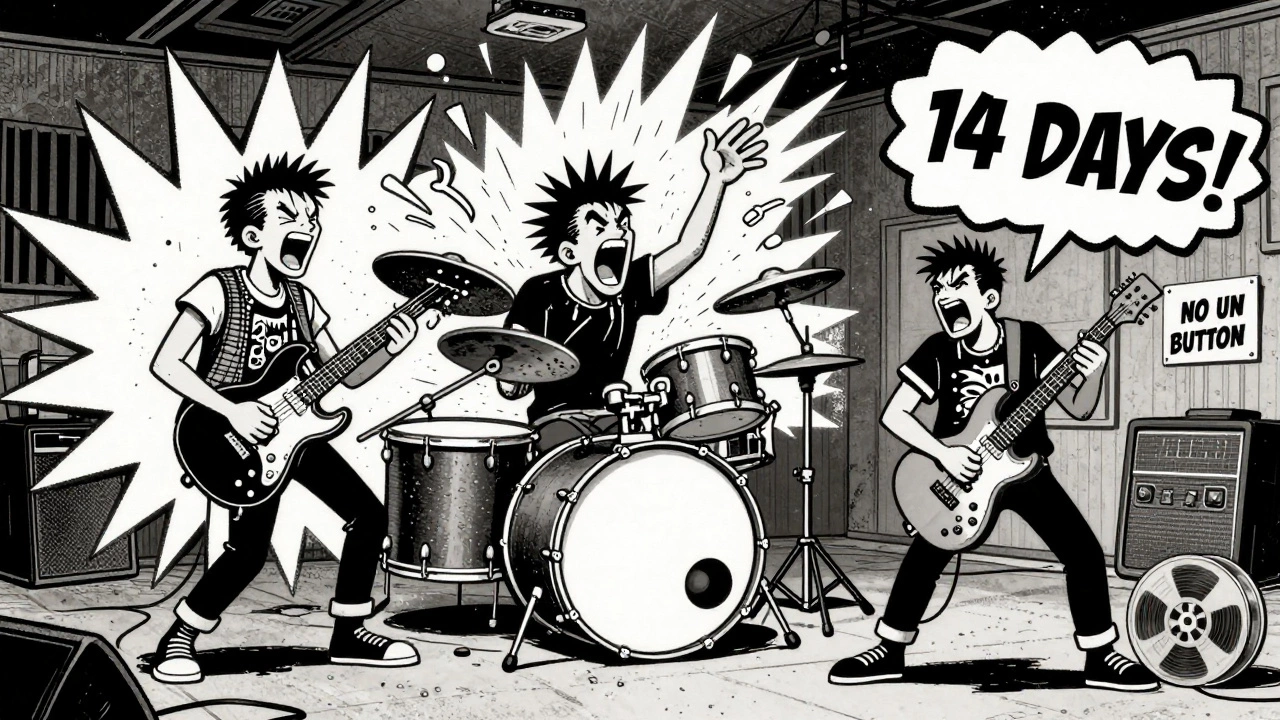
Band members often slept in the studio. The Offspring recorded Smash in 14 days for $20,000-a luxury by indie standards. They lived in the studio. Ate pizza. Played the same songs over and over until the takes felt alive. That’s why albums from this era have a raw, live feel. There was no time to overdub. No time to fix mistakes. The performance had to be real.
Tight Mixes: How Engineers Made Chaos Sound Clear
You might think fast recording meant sloppy mixing. But that’s not true. In fact, the opposite. Because the recordings were so live, the mixing had to be razor-sharp to keep everything from turning into mud.Engineers used a "bottom-up" approach. They started with the drums. Not the vocals. Not the guitars. The drums. Why? Because in punk, the drums drive everything. They set the tempo. They carry the energy. So they built the whole mix around them.
Snare drums were mic’d with extreme precision. Two mics: one on top, one underneath. The top mic was usually a Shure SM57, placed at 140 degrees from the hi-hat to reduce bleed. The bottom mic captured the snare wires. Both were phase-aligned by hand-sometimes taking hours. The snare was then boosted at 7kHz with an API Vision channel strip for that crisp "crack." But here’s the trick: they didn’t compress it much. Usually just 2:1 or 3:1 ratio, with a 10-20ms attack time. This kept the transients alive. The snare didn’t just hit-it exploded.
Guitars were recorded with two mics: a Sennheiser MD-421 right on the amp speaker, and a Neumann U89 about a meter back to catch room sound. The amps were pushed into natural distortion. No pedals. No plugins. Just cranked tube amps. And here’s something most modern producers don’t realize: they overloaded the preamps. Not by accident. On purpose. Two to three percent harmonic distortion from analog gear gave the guitars that gritty, in-your-face tone you hear on every classic 90s punk record.
Bass was rolled off below 40Hz with an API 550B EQ. Why? Because fast punk tempos (160-220 BPM) meant the bass had to be tight. Too much low-end mud, and the drums would disappear. So they cut the rumble. They didn’t boost the bass-they carved space for it.
Vocals? High-passed at 80Hz. No reverb. No delay. Just a clean, direct signal. Sometimes with a little compression. But never enough to smooth out the rawness. The goal was clarity, not polish. As mix engineer Tom Lord-Alge said in 2021: "If you can’t understand half the lyrics, you’re doing it right. That’s punk. It’s not a pretty song. It’s a pissed-off song."
Big Drums: The Secret Sauce Behind the Sound
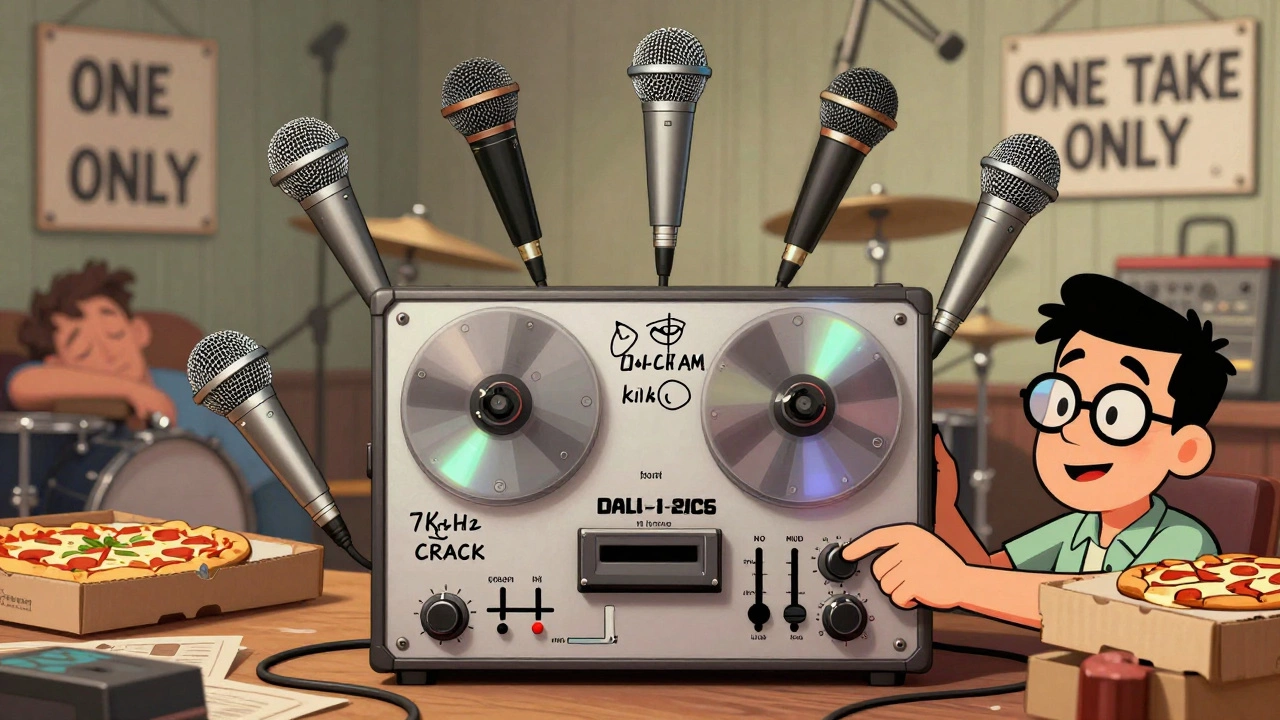
"Big drums" wasn’t just a phrase. It was a technique. And it wasn’t about adding reverb or samples. It was about mic placement, tape saturation, and surgical EQ.Drum kits were mic’d with 8-9 microphones: kick, snare, toms, hi-hat, room mics. The kick drum? Usually a Shure Beta 52 or AKG D12. The snare? SM57 on top, C12 underneath. Room mics were often Coles 4038s, placed 8-10 feet back to capture the whole room’s energy.
The magic happened on tape. Studios like Westbeach Recorders in LA ran Studer A800 machines at 30 ips with 10dB of saturation. Tape doesn’t just record sound-it warms it. It adds subtle harmonics. It compresses transients gently. That’s why 90s punk drums sound bigger than modern ones. Digital tools can emulate tape, but they can’t replicate the physical interaction of magnetic particles on a spinning reel.
And the tuning? It was obsessive. Drummers used a Tune-bot to match lug pitches within 3-5 cents. Why? Because at 180 BPM, even a 10-cent difference between the top and bottom head of a snare would create a phasing issue. You’d hear a wobble. A flutter. A weakness. That’s not punk. That’s amateur.
Bad Religion’s producer Brett Gurewitz once said they did 78 takes of "21st Century (Digital Boy)" before they got one that felt right. Not because the drummer was bad. Because every hit had to be perfect. The energy had to be consistent. The timing had to be tight. The sound had to be huge. And if it wasn’t, they started over.
Why This Sound Doesn’t Work the Same Today
Modern producers have every tool imaginable. Pro Tools. Auto-Tune. Virtual amps. AI mastering. But none of that helps if you don’t have the constraints that forced creativity.Back then, you had 24 tracks max. No more. You couldn’t layer 12 guitars. You couldn’t comp 50 vocal takes. You had to get it right live. That pressure created urgency. That urgency created emotion.
Today, 78% of rock albums use over 100 tracks. That’s not punk. That’s a studio experiment. Punk was never about how many tracks you used. It was about how much heart you put into the few you had.
And here’s the irony: modern plugins like Universal Audio’s Studer A800 emulation are used on 42% of punk-inspired tracks today. Softube’s SSL 4000 G is on 68% of modern punk mixes. But those are tools. They don’t replace the mindset. You can’t just slap on tape saturation and call it 90s punk. You have to record fast. You have to mix tight. You have to let the drums scream.
What Got Lost-and What’s Coming Back
Critics like Robert Christgau called out the 90s punk sound for burying vocals under snare hits. And he was right. On albums like Americana, you can barely make out half the lyrics. But that wasn’t a mistake. It was a statement. The drums weren’t meant to be "balanced." They were meant to be dominant. They were the heartbeat.And now? That’s coming back. A 2022 survey by Pro Mix Academy found that 82% of punk musicians still say drum sound is the most important part of the record. 63% specifically want that "hard-hitting, uncompressed snare" from the 90s.
Modern bands are deliberately limiting themselves. They’re recording in 7 days. They’re using analog chains. They’re refusing to quantize. Why? Because they know the magic wasn’t in the gear. It was in the pressure. The time limit. The one-shot mentality.
SPOT, the legendary SST engineer who shaped punk’s earliest sounds, put it best: "The magic came from knowing you had one shot. Digital undo has killed that tension."
But tension is what punk was built on. And it’s coming back-not because we’re nostalgic, but because we’ve realized that perfection is boring. Energy isn’t something you fix in post. It’s something you capture in the moment.
How to Recreate the 90s Punk Sound Today
If you want to make a punk album that sounds like it came from 1995, here’s what actually works:- Record drums in one or two days. No more. Use real mics. No samples. Tune every drum with a Tune-bot.
- Use analog saturation. Run your signal through tape emulation (like UA Studer A800) on every track. Even vocals. Even bass.
- Overload your preamps. Push your mic pre’s gain until you see 2-3% harmonic distortion. That’s the sweet spot.
- High-pass everything. Cut below 100Hz on guitars, vocals, even bass. Let the kick and snare own the low-end.
- Don’t compress the snare. Use 2:1 or 3:1 ratio. Fast attack. Long release. Let it breathe.
- Record live. No overdubs. No comping. If the bassist flubs, they re-record the whole song. No exceptions.
- Limit yourself to 24 tracks. If you need more, you’re doing it wrong.
And here’s the final rule: if you can play it live without a click track and it still sounds like a record, you’re on the right path.
Why did 90s punk albums sound louder than modern ones even though they weren’t mastered as loud?
They weren’t louder in peak volume-they were louder in perceived energy. Modern mastering pushes everything to -6 LUFS, squashing dynamics. 90s punk albums stayed around -14 LUFS. That meant transients stayed sharp. The snare hit like a punch. The kick had body. The guitars crackled. It wasn’t about loudness. It was about impact. You felt it in your chest.
Can I use digital plugins to get the 90s punk sound?
Yes, but only if you mimic the workflow, not just the gear. Plugins like Universal Audio’s Studer A800 or Softube’s SSL 4000 G can emulate the saturation and EQ. But if you’re recording 100 tracks, overdubbing vocals, and quantizing drums, you’re not making punk-you’re making pop. The sound comes from the process: fast, live, raw. The tools just help.
Why did 90s punk bands use so few tracks?
Digital workstations in the early 90s could only handle 8-24 tracks at 44.1kHz. Pro Tools 1.0 (1991) was limited and expensive. Bands didn’t have the option to layer. So they focused on performance. That limitation forced creativity. You had to make every track count. That’s why albums like Smash sound so full-because every note had purpose.
Was the 90s punk sound only from Southern California?
No. Southern California bands like NOFX and The Offspring had a brighter, more polished sound thanks to Epitaph’s production. But East Coast hardcore, like bands from Dischord Records, kept a rawer, grittier tone inherited from SPOT’s work with Black Flag. The "big drums, tight mixes" approach was universal-but the tone varied by region. California was cleaner. New York was dirtier. Both were loud.
Why did producers boost the snare at 7kHz?
That frequency range is where the "crack" lives. Boosting 7kHz made the snare cut through distorted guitars and fast tempos without needing to turn up the volume. It didn’t make the snare louder-it made it clearer. And in punk, clarity meant aggression. You didn’t need reverb. You needed presence. And 7kHz gave it.


