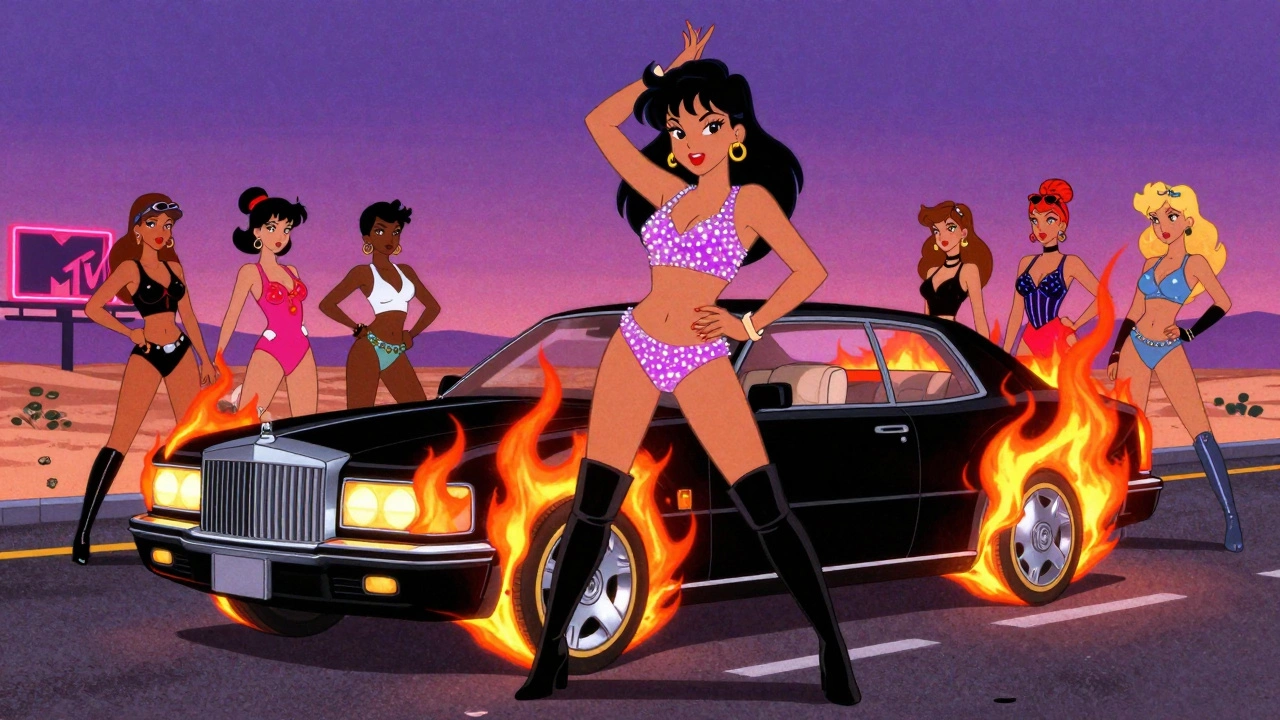

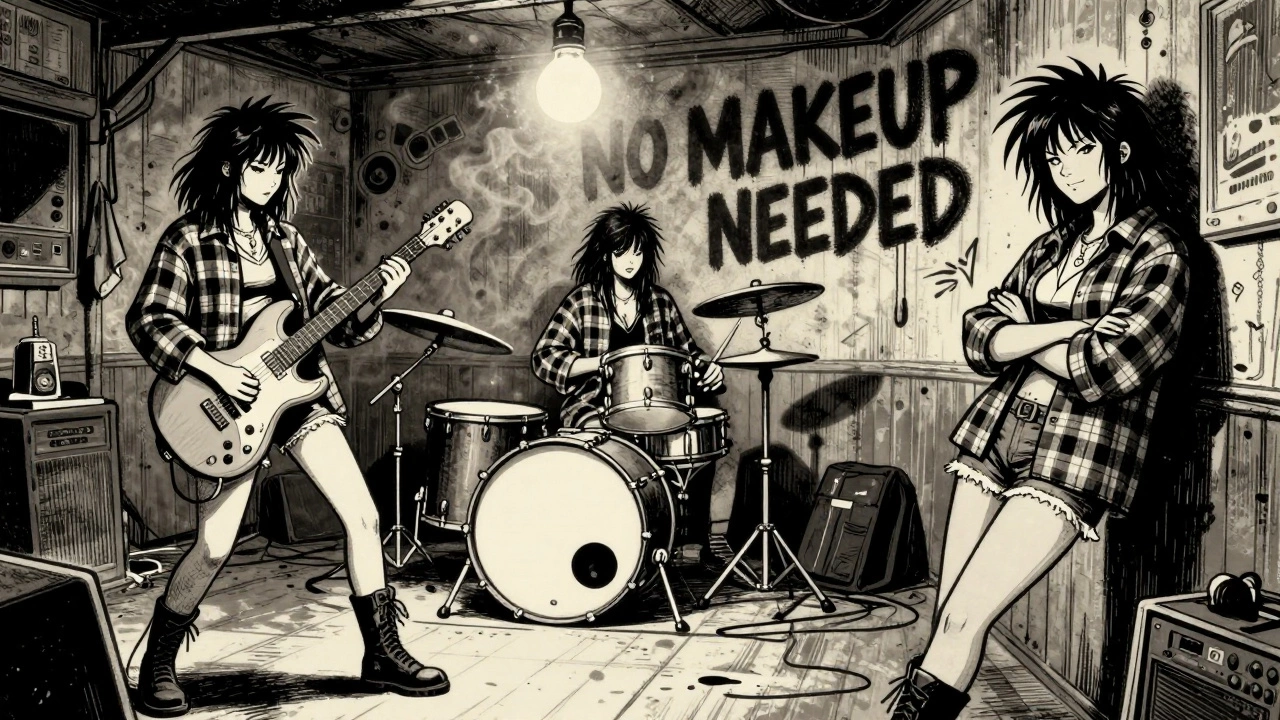
The 1990s were a wild time for music videos. On one side, you had women in crop tops and thigh-high boots shaking their hips in front of burning cars. On the other, you had women in flannel shirts and combat boots, leaning against a wall like they didn’t care if you were watching. Both were real. Both were everywhere. And both told us something about what society expected from women in music-and how some artists pushed back.
Sex Object or Star? The MTV Formula
MTV didn’t invent the idea of women as eye candy in music videos, but in the '90s, it turned it into a factory. If you were a female artist in pop, R&B, or hip-hop, your video usually followed the same script: sex object first, singer second. Think of videos where women danced around a man’s car, draped over a piano, or rolled around in silk sheets while the artist sang about heartbreak. These weren’t accidents. They were formulas.
Research from the time showed that women in these videos were almost always dressed provocatively, rarely had speaking roles, and were never shown doing anything that didn’t involve their bodies. Men? They were drummers, guitarists, rappers, bosses, adventurers. Women? They were props. Background. Eye candy. A 1999 study found that women exposed to these kinds of videos were more likely to accept that violence against women was normal. That’s not just troubling-it’s terrifying.
And the body standards? Unreal. In hip-hop videos especially, women were often underweight, airbrushed, and posed in ways that made them look like mannequins. A focus group of college women in the late '90s said they looked at these videos and felt like they were failing. Not because they couldn’t sing. Because they couldn’t look like that.
Madonna: The Queen of Contradictions
If you were going to pick one woman who defined the '90s music video, it was Madonna. She wasn’t just a pop star. She was a lightning rod. In her videos, she played the virgin, the stripper, the pregnant teen, the dominatrix. She claimed she was in control. And maybe she was. But she was also playing by MTV’s rules.
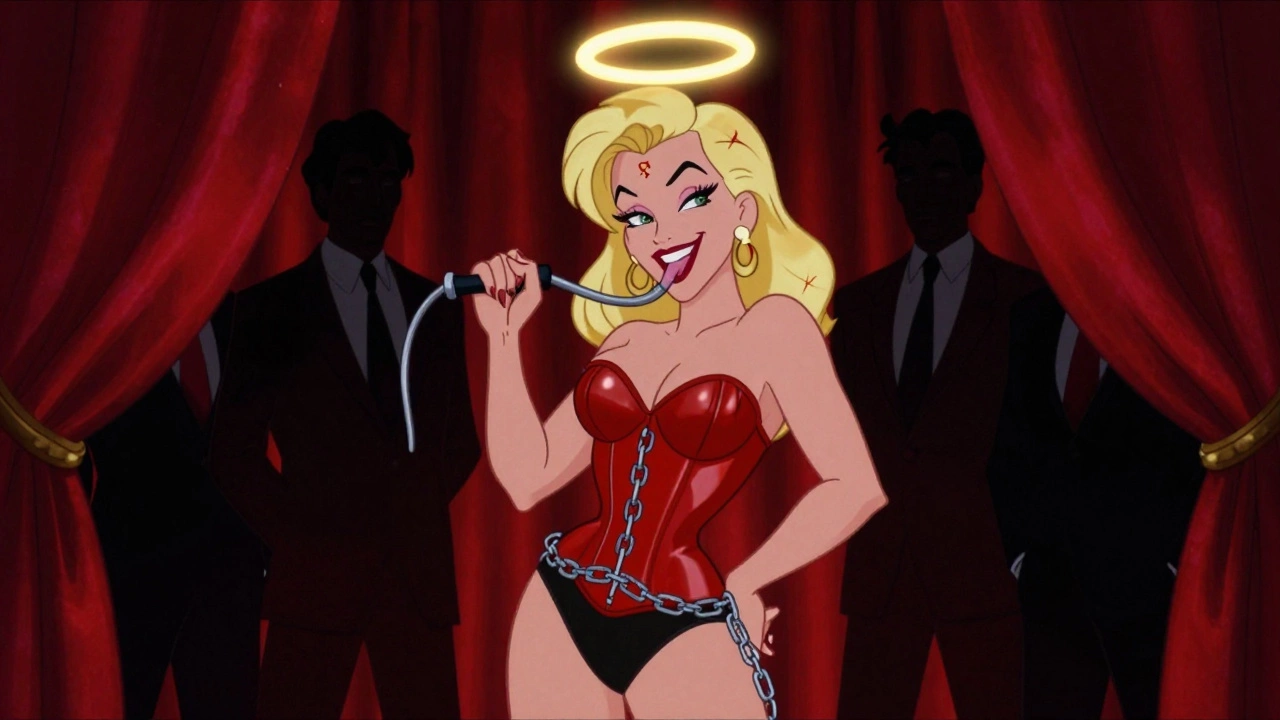
Her video for "Justify My Love" showed her in chains, wearing leather, licking a whip. "Erotica" had her in a corset, surrounded by men in suits. She was saying, "I own my sexuality." But the camera still treated her like a fantasy for men. She didn’t break the system-she became its most profitable symbol. Young girls watched her and thought, "I can be powerful like her." But what they saw was a woman performing power in a way that still made her palatable to men in boardrooms.
Madonna didn’t invent the trope. But she made it impossible to ignore. And that’s why she’s still talked about today.
Grunge: The Quiet Rebellion
While pop videos were busy turning women into lingerie models, something quieter was happening in Seattle. Grunge didn’t care about glitz. It cared about truth. And in grunge videos, women didn’t need to be sexy to be seen.
Look at videos from bands like Hole, L7, or even Nirvana’s "Smells Like Teen Spirit"-women wore baggy jeans, flannel shirts, no makeup, messy hair. They stood in the corner. They played guitar. They looked bored. They looked real. There was no choreography. No camera lingering on their legs. No slow-motion hair flip.
This wasn’t a fashion statement. It was a middle finger. In a decade where every other video screamed "look at me," grunge women said, "I’m here. Don’t stare." And for a brief moment, it worked. Women in alternative scenes didn’t have to look like they were on a runway to be taken seriously. They just had to be themselves.
But here’s the catch: grunge was a niche. It didn’t hit the same numbers as TLC or Mariah Carey. MTV didn’t play it all day. So while it was revolutionary, it was also invisible to most people.
Who’s Really in Control?
Here’s the messy part: were these women victims? Or were they making choices?
Some artists wore tight clothes because they liked it. Others did it because their label demanded it. Some refused to do sexualized videos and got dropped. Others doubled down and got rich. There’s no clean answer.
Take TLC. Their "Waterfalls" video showed a woman dying of AIDS, a man in a gang, and a drug dealer. But in their other videos? They wore crop tops and short shorts. Were they selling out? Or were they using the system to get their message out? The answer is both.
And then there’s the audience. A study of young women watching music videos found they didn’t just accept what they saw. They laughed. They rolled their eyes. They mocked the clichés. They knew it was fake. But they still watched. Because the music was good. Because the beat made them move. Because sometimes, even when you hate something, you still can’t look away.
The Legacy: Still Here
Today, you can still see the '90s in today’s videos. The low-rise jeans. The hip thrusts. The slow zoom on a woman’s backside. The way cameras linger longer on women than men.
But something’s different now. Artists like Beyoncé, Lizzo, and Billie Eilish don’t just perform-they demand control. They write their own concepts. They hire their own directors. They refuse to be reduced to one look.
The '90s taught us that women in music videos don’t have to be one thing. They can be sexy and smart. They can be rebellious and commercial. They can be both object and subject. The struggle wasn’t about choosing between empowerment and exploitation. It was about realizing that the system didn’t have to be the final word.
Women didn’t wait for permission to change things. They just did it-sometimes in lace and heels, sometimes in flannel and boots. And that’s the real legacy of '90s music videos: no single story defines them. But every story matters.
Why were women in '90s music videos so sexualized?
MTV’s audience in the '90s was mostly young white men, and the network believed that’s what they wanted to see. The formula was simple: women in tight clothes, dancing, looking at the camera seductively. It worked. Sales went up. Advertisers were happy. So the industry kept doing it-even as critics and scholars pointed out how harmful it was. It wasn’t about talent. It was about profit.
Did any female artists refuse to play along?
Yes. Artists like Tracy Chapman, Fiona Apple, and the members of Hole often rejected sexualized visuals. Chapman’s videos focused on storytelling, not her body. Apple’s "Criminal" video showed her in a dark room, looking tired and real-not glamorous. Hole’s "Miss World" featured women in plain clothes, covered in dirt, screaming. These were rare, but they mattered. They proved there was another way.
How did grunge change the game for women in music videos?
Grunge removed the fantasy. Instead of shiny floors and choreographed dances, you got dim lighting, messy hair, and women playing instruments like they meant it. No one was trying to seduce anyone. No one was posing. Women in grunge videos were part of the band, not decoration. It didn’t make them famous on MTV-but it gave a whole generation of girls permission to be loud, awkward, and real.
Did women in '90s music videos have any real agency?
It’s complicated. Some women were pressured. Others used the system to gain power. Madonna dressed like a sex symbol but wrote her own songs and directed her own videos. TLC wore revealing outfits but controlled their message and made millions. Agency didn’t mean rejecting every stereotype-it meant choosing which ones to use, and which ones to fight. The most powerful women in '90s music weren’t the ones who refused to play the game. They were the ones who changed the rules while playing.
Are these tropes still around today?
Absolutely. You still see women in videos being filmed from below, with slow zooms on their hips, dancing around men who never move. But now, more artists are pushing back. They’re directing their own videos. They’re wearing hoodies instead of heels. They’re calling out the double standards. The '90s didn’t solve it-but they started the conversation. And that’s why we still talk about it.


