
By the early 1990s, music classes in American public schools were on life support. Budget cuts had slashed programs to the bone. In Los Angeles, just 72 music teachers were spread across 360 elementary schools-each one responsible for over 1,300 students a week. Some schools had no music teacher at all. The lessons that remained? One hour a week of singing "Shenandoah" while a teacher played a scratchy vinyl record. No instruments. No composition. No real connection to the music students actually listened to outside school.
But something was shifting. While the system was crumbling, a quiet revolution was brewing in the corners of these classrooms. It wasn’t led by administrators or policymakers. It was driven by teachers who refused to give up-and by the technology that was suddenly within reach.
When the Classroom Met the Synthesizer
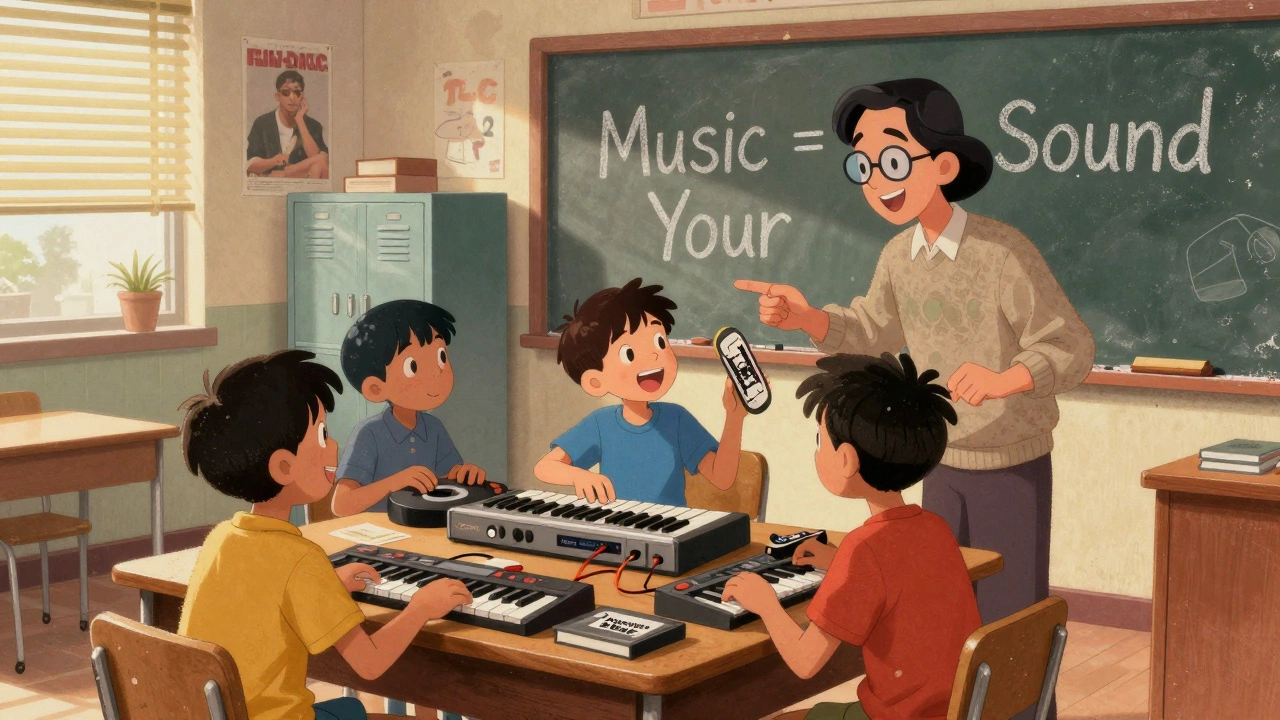
Before the 1990s, music education meant piano, band, and orchestral scores. If you were lucky, you got to play a recorder. But by 1993, something new started showing up: cheap digital keyboards, basic MIDI interfaces, and cassette-based multitrack recorders. Schools that couldn’t afford a full brass section could buy a $300 keyboard and a $200 sampler. Suddenly, students weren’t just learning to read notes-they were learning to make beats.
At a middle school in Chicago, a teacher named Maria Lopez turned her struggling music class into a recording lab. She didn’t have a single violin. But she had six Casio keyboards and a four-track cassette recorder. Her students started sampling their own voices, layering drum patterns from old hip-hop cassettes, and writing songs about their neighborhoods. One student, 14-year-old Jamal, made a track using the sound of his locker slamming and his sneakers squeaking on the hallway floor. He didn’t know what a staff was, but he knew rhythm. He didn’t need to read music to make something that moved people.
This wasn’t theory. It was survival. Schools that kept music alive did it by embracing what students already cared about: pop, hip-hop, R&B. The old curriculum-focused on Mozart and Bach-felt irrelevant. But when students could record their own version of a TLC song or remix a reggae beat, they showed up. Attendance rose. Confidence grew. And for the first time in years, some kids started talking about music as something they could do, not just listen to.
The Curriculum That Broke the Rules
In 1992, the UK’s National Curriculum for Music made headlines by requiring schools to teach rock, pop, and world music alongside classical pieces. It was a radical move. For the first time, students weren’t just learning music-they were learning about culture through sound. In the U.S., there was no federal mandate, but teachers began quietly adopting similar ideas. In California, a teacher in Oakland started a unit called "Music of the African Diaspora," where students learned about calypso, soul, and Afrobeat-not as history lessons, but as living traditions they could replicate.
Lucy Green’s research on how pop musicians learn by ear-without sheet music-started showing up in teacher workshops. She found that kids who struggled in traditional music class often thrived when they learned by copying songs they loved. One teacher in Seattle began letting students bring in CDs and transcribe basslines by hand. No theory tests. No scales. Just listening, repeating, and figuring it out. By the end of the semester, students who had been labeled "musically disabled" could play entire songs on piano. They didn’t know the difference between a dominant seventh and a minor third, but they could feel it.
These weren’t official policies. They were grassroots workarounds. Teachers were creating new curricula out of necessity. They used whatever they had: a single computer with Music Writer software, a boombox with a tape loop, a drum machine from a garage sale. They didn’t wait for permission. They just started.
The Technology That Changed Everything
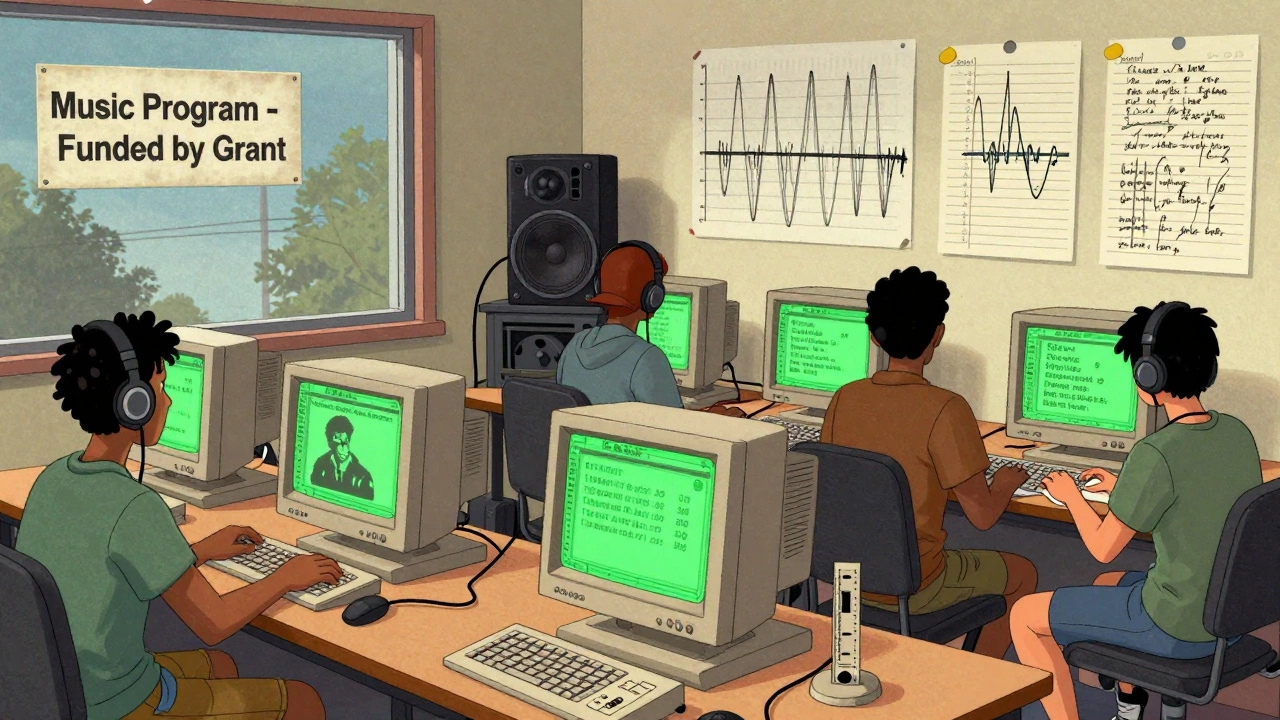
The real game-changer wasn’t just the gear-it was the idea that music could be made without years of training. In 1995, Apple released the first version of SoundJam, which later became iTunes. Around the same time, free or low-cost software like Cakewalk and Steinberg Cubase became available for Windows PCs. Suddenly, a high school student could record, edit, and mix a song on a computer that cost less than a guitar.
One school in Detroit got a grant for five old PCs. The music teacher, Ray Johnson, turned them into a recording studio. Students recorded spoken-word poetry over beats they made themselves. They didn’t have amplifiers, so they used headphones. No studio monitors? They used the school’s broken PA system. The results weren’t polished. But they were real. One student’s track about losing his brother to violence won a regional youth arts contest. It was played on a local radio station. For the first time, the school’s music program had a public voice.
Recording wasn’t just a tool. It was an act of validation. When students heard their own voices on tape, they stopped thinking of music as something reserved for prodigies. It became something they could claim.
The Fight to Stay Relevant
But the system wasn’t ready. In 1991, the National Commission on Music Education warned that music was being pushed to the "periphery" of public education. Only 29 states required arts for graduation-and 13 of them let students substitute foreign language, home economics, or even computer science. In California, a 1983 law had made it legal for college-bound students to skip music entirely if they took Spanish instead. "You don’t have to sell math," said one parent activist. "But when it comes to music, some people see it as a frill."
Teachers fought back by tying music to test scores. They pointed to studies showing that students in music programs scored higher in math and reading. They argued that learning rhythm improved pattern recognition. That composing songs built problem-solving skills. That playing in a band taught teamwork. It wasn’t enough to say music was beautiful-they had to prove it was academic.
Some districts responded. In Glendale, California, an influx of Asian families who valued piano lessons helped revive instrumental programs. In Portland, Oregon, a coalition of parents, teachers, and local musicians lobbied the school board for years. They didn’t ask for more money. They asked for recognition: that music wasn’t extra. It was essential.
Who Got Left Behind?
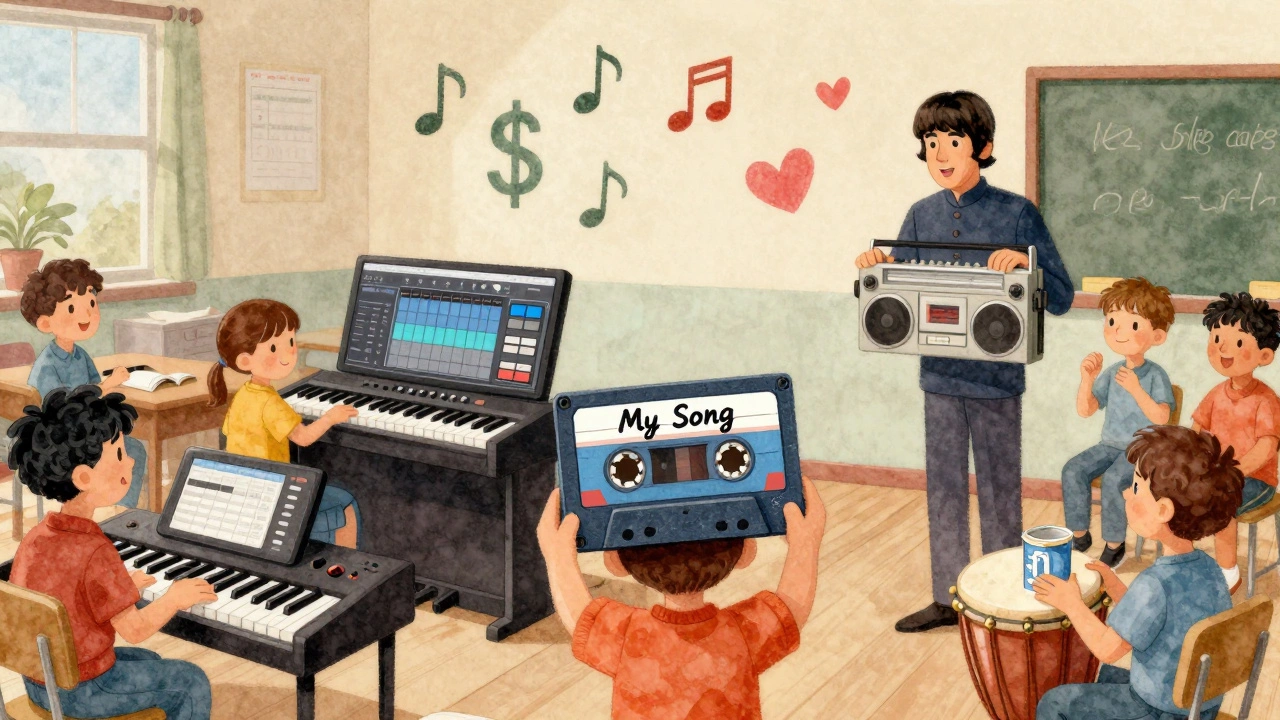
But access was never equal. Wealthy districts bought digital pianos and Pro Tools licenses. Poor districts got broken instruments and outdated textbooks. In rural Alabama, a high school teacher used a donated boombox to teach harmony by playing Beatles songs and asking students to hum along. In New York City, a magnet school had a full studio with MIDI controllers and audio interfaces. The gap wasn’t just about money. It was about belief. Some schools still saw music as decoration. Others saw it as a lifeline.
The students who benefited most were those who didn’t fit the traditional mold. Kids who struggled in math or reading found their voice in a beat. Students who felt invisible in the hallway found confidence when their song played over the PA system. For many, music class was the only place they felt heard.
The Legacy of the 1990s
By 2000, the music classroom looked nothing like it had in 1990. The piano was still there. But now it shared space with a laptop running GarageBand. The choir still sang. But so did a hip-hop crew recording in the auditorium after school. The old curriculum hadn’t disappeared-it had expanded.
The 1990s didn’t fix music education. But they showed that it could adapt. When resources vanished, creativity didn’t. When policies ignored students’ lives, teachers found ways to bring those lives into the classroom. Recording technology didn’t replace tradition-it redefined it. Music wasn’t just about playing notes anymore. It was about making meaning.
Today’s music tech tools-AI generators, cloud-based collaboration, mobile DAWs-are just the next step in that same story. The same questions remain: Who gets to make music? Who gets to be heard? And who decides what counts as "real" music?
The 1990s answered those questions with action, not arguments. And that’s the lesson that still matters.


